
The Psychedelic Yoga

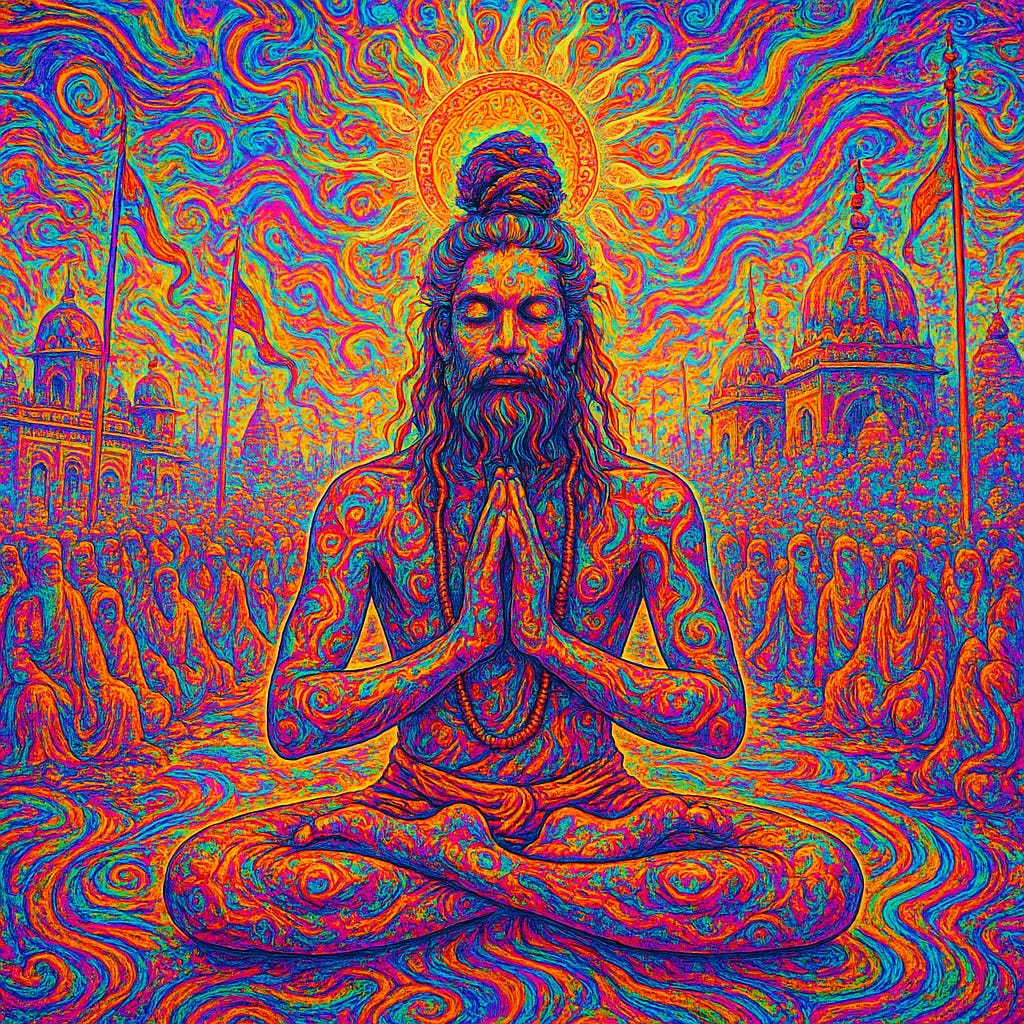
Yoga, an ancient spiritual and physical practice from India, includes various methodologies promoting heightened awareness. Practices such as Kriya Yoga, Tantric techniques, Pranayama (breathwork), meditation, cleansing rituals (Shatkarmas), and adherence to a Sattvic diet have been reported to induce altered states of consciousness similar to those experienced with psychedelic substances. This article explores how these traditional methods facilitate deep self-exploration and expanded awareness, potentially offering a natural pathway to transcendental experiences without pharmacological intervention.
For millennia, Indian yogic traditions have provided structured methodologies to achieve profound mental, emotional, and spiritual states. With the increasing interest in non-ordinary states of consciousness, many researchers and practitioners have explored the parallels between yogic experiences and those induced by psychedelics. Unlike external substances, yogic practices cultivate altered consciousness through disciplined mental and physical engagement, allowing for self-regulation and spiritual insight. This paper examines various yoga practices and their potential to induce psychedelic-like states.
Kriya Yoga and Tantric Practices
Kriya Yoga, a disciplined practice involving controlled breathwork, meditation, and visualization, has been noted for its ability to induce heightened states of awareness. According to Paramahansa Yogananda, Kriya Yoga accelerates spiritual evolution by focusing energy along the spinal axis, leading to profound inner experiences and bliss states akin to those reported in psychedelic journeys.
Similarly, Tantric practices involve energy cultivation, mantra chanting, and deep meditative absorption to transcend ordinary perception. Techniques such as Kundalini awakening aim to activate latent energy (Shakti) at the base of the spine, leading to visions, out-of-body experiences, and a dissolution of ego boundaries comparable to the effects of psychedelics.
Real-life examples include Ramakrishna Paramahansa, a 19th-century Indian mystic, who described experiencing divine ecstasies and visions through his intense devotional and tantric practices. Similarly, Neem Karoli Baba, an Indian saint, was known for his profound states of transcendental consciousness, which many of his followers compared to psychedelic experiences.
Pranayama and Breathwork Practices
Controlled breathing techniques, or Pranayama, are integral to yogic disciplines. Practices such as Bhastrika (bellows breath), Nadi Shodhana (alternate nostril breathing), and Kapalabhati (skull-shining breath) significantly influence brainwave activity and neurochemical responses. Studies have shown that deep breathing can enhance gamma and theta wave activity, leading to altered states of consciousness similar to those induced by substances like psilocybin.
Holotropic breathwork, derived from Pranayama techniques, has been reported to evoke profound emotional catharsis and transcendental states. The hyper-oxygenation of the brain during these practices may stimulate the endogenous release of neurotransmitters such as serotonin and DMT, which are also implicated in psychedelic experiences.
Notable practitioners include Wim Hof, known as “The Iceman,” who has demonstrated extraordinary altered states of consciousness through breathwork and cold exposure. Similarly, Swami Rama, an Indian yogi, exhibited scientifically documented control over his autonomic nervous system through advanced breath control, often entering states resembling psychedelic experiences.
Meditation and Its Role in Altered States
Meditative practices, particularly those emphasizing deep concentration and mindfulness, are known to induce ego dissolution and a sense of unity consciousness. Advanced meditators often report experiences of ineffable bliss, time distortion, and mystical insights similar to those found in psychedelic states.
Techniques such as Vipassana and transcendental meditation encourage deep introspection, reducing activity in the brain’s default mode network (DMN). Research suggests that DMN suppression correlates with the dissolution of self-boundaries, a hallmark of both psychedelic and meditative experiences.
A well-documented case is that of Buddha himself, whose deep meditative states led to enlightenment, described as an ultimate transcendental experience. Another example is St. Teresa of Avila, a Christian mystic who reported experiencing profound spiritual ecstasies and visions through deep meditative prayer.
Cleansing Practices and Sattvic Diet
Shatkarmas, or yogic cleansing techniques, include nasal irrigation (Neti), stomach cleansing (Dhauti), and intestinal purification (Basti). These practices purify the body and mind, enhancing clarity and receptivity to meditative states.
Diet also plays a crucial role in consciousness expansion. A Sattvic diet, rich in fresh fruits, vegetables, and minimal stimulants, is believed to enhance mental clarity and facilitate spiritual awakening. The exclusion of tamasic (dulling) and rajasic (agitating) foods aligns with practices that seek to elevate consciousness naturally.
Many Indian saints, including Swami Sivananda, advocated a strict Sattvic diet to maintain high spiritual awareness. Similarly, Pythagoras, the ancient Greek philosopher, followed a vegetarian diet and engaged in fasting to enhance his mental clarity and mystical experiences.
Modern Scientific Exploration of Psychedelic-like States Through Yoga
Modern neuroscience and psychological research are increasingly interested in the mechanisms by which yoga induces altered states of consciousness. Advanced neuroimaging tools such as functional magnetic resonance imaging (fMRI), electroencephalography (EEG), and magnetoencephalography (MEG) can monitor real-time changes in brain activity during meditative and breathwork practices.
For instance, fMRI studies have shown that meditative states can reduce activity in the default mode network—similarly observed in individuals under the influence of psychedelics like LSD and psilocybin. EEG studies have revealed increased theta and gamma wave activity, associated with deep emotional processing and mystical experiences. A notable EEG study by Cahn and Polich (2006) documented that long-term meditators exhibit significantly higher theta and gamma activity, correlating with transcendent states of consciousness.
Additionally, a study by Kalyani et al. (2011) using fMRI found that specific yoga practices, such as cyclic meditation, activated brain regions associated with attention, interoception, and emotional regulation—similar to areas stimulated during psychedelic experiences. Another fMRI study by Braboszcz et al. (2017) highlighted increased neural connectivity and reduced DMN activity during meditation, mirroring brain patterns seen in psilocybin-induced states.
Emerging research into endogenous DMT production suggests that yogic breathwork and deep meditation might stimulate pineal gland activity, opening new avenues for understanding consciousness through a scientific lens.
Furthermore, collaborations between neuroscientists, psychologists, and experienced yogis are beginning to formalize research protocols that validate traditional wisdom with empirical evidence. These explorations not only enhance our understanding of mind-body interactions but also pave the way for therapeutic interventions targeting anxiety, depression, and PTSD without the need for pharmacological substances.
Traditional yogic practices offer a structured and sustainable approach to achieving altered states of consciousness without external substances. By integrating breathwork, meditation, energy work, and dietary mindfulness, individuals can access transcendental states akin to psychedelic experiences. Historical and contemporary figures demonstrate that these practices can lead to profound states of awareness, making them a valuable path for those seeking spiritual and personal transformation. As scientific research continues to explore the neurophysiological mechanisms behind these practices, their potential therapeutic and transformative benefits warrant deeper exploration.
By Sakshi Upadhyay
 | A guest post by
|